
Why am I doing this?
Am I crazy?

There’s been an exponential increase in internet-grifting behaviors and the promotion of misinformation in the wellness and healthcare space. You know it, I know it. If you don’t know it, here’s your chance.
“Misinformation is spreading false, misleading, or inaccurate information, often without malicious intent. It differs from disinformation, which is intentionally deceptive, but the effects of both can be equally harmful. In an age where information travels rapidly through social media, news outlets, and online platforms, misinformation can easily reach and influence a vast audience, shaping opinions, behaviors, and even policies. The impact on society is significant: misinformation can lead to public confusion, mistrust in reliable sources, and harmful behaviors, particularly in areas like public health, politics, and science.”
How did we get here?
If you’re familiar with short-form video content, you’ll know that the name of the game from a content creation standpoint is to get people to stop scrolling and pay attention to what you have to say.
How do you do that?
It’s unfortunately not easy when you’re presenting information in a calm manner with healthy skepticism and claims that further research is necessary.
If you’re good at engagement-farming, it may go something like:
STOP SCROLLING! Did you know the previously-regarded-as-healthy-thing-you-do-every-day is killing you?
That’s right! A study found [insert screenshot of an abstract] that this item regarded as safe has things in it that could kill you and make you infertile and drop your testosterone [or, insert other appeal to fear]
Then, they’ll end with something like “Comment ‘GUIDE’ and I’ll DM you my guide to [insert sale here]
Or, if they’re communicating in a static post, it may be Randomly Capitalized words with arbitrary concepts not clearly understood or explained paired with a subtle insinuation that you’re an idiot because whatever you do, you won’t have as much mastery of the topic at hand as they do.
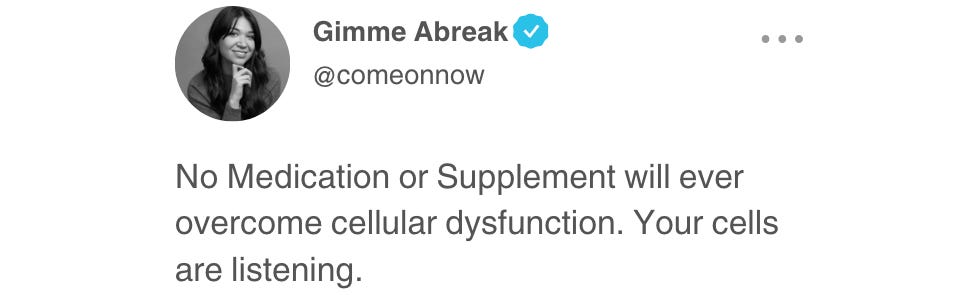
I was actually told by a friend that the above tweet, which I did not tweet but actually made on Canva, is scarily similar to one posted by a prominent figure not long before me. Do we laugh? Do we cry? What do we?
What do we do?
I won’t lie to you, I have not known what to do about this. There have been times when I wondered if I was going to make it as a naturopathic doctor because I was just so exhausted by the misinformation.
But I like working with patients, I’m not ready to leave!
I’ve had productive conversations with individuals who were vaccine hesitant who then went to get a DTAP vaccine after our visit. Polio is actually something I’m incredibly unqualified to treat and is in fact on the rise.
I’ve supported individuals with complex chronic illnesses as they navigate their specialist appointments, and helped them get the best out of their healthcare. I’ve worked with them on their diet, corrected nutritional deficiencies, and added evidence-based nutraceuticals to help keep them from progressing and help them to modify their disease process and feel better.
I’ve helped people lose stubborn weight naturally without detoxing or lowering their cortisol. Spoiler alert: weight loss takes time and half of the battle is not giving up when it feels frustrating, sticking to the nutrition parameters we create together, and enjoying some delicious foods every so often so you don’t binge the moment you feel like giving up.
I’ve sat across the room from patients with active cancer who are scared to pursue conventional treatment. I’ve referred them to wonderful oncologists and made sure that implement strategies that promote survivorship while they go through treatment, and provide evidence-based interventions that harmonize with their therapy. I have literally watched their tumors shrink as the medications I counseled them on accepting from their oncologists, and the complementary interventions I introduced, did what the research on them said it would.
The truth is,
there is a place at the table for ND’s and functional medicine practitioners who are feeling nudged out of a profession that is currently feeling rife with misinformation. There will always be a place for Naturopathic doctors in the collaborative model of patient care.
The task at hand is simple, and ought to start by properly examining the structures and deficits that got us here.
Namely:
People are learning more about alternative medicine with the advent of social media, but they’re often learning it from practitioners who aren’t licensed.
We need: a better system of identifying naturopathic, functional, and integrative healthcare providers that are evidence-based and committed to practicing medicine that benefits not only the person in front of them but the public at large.
Exploration: What is the current framework of alternative medicine?
At present, we lack a system of guidelines that drive patient care
This is not inherently a bad thing, in fact it allows for a wide range of practitioners and specialties in a marketplace style for consumers
BUT! Patients should be able to go to an ND or functional medicine physician and receive a diagnosis that is replicable. This is especially true when naturopathic care is often out of pocket and individuals are making big investments in the name of healthcare.
How do people find us? The current landscape of social media allows for the practitioner to reach maximum exposure
This is not inherently a bad thing either, it allows for more individuals to receive care
BUT! When the current social media algorithms don’t even show you your own friends on your feeds, but rather promoted content and ads, inflammatory content prevails as it targets the fear reflex in the user.
Ultimately, social media will always prioritize engagement over accuracy.
Naturopathic, functional and alternative medicine promotes “personalized and individualized care” while often forgetting the community.
This is originally a great thing - genetically, environmentally, historically, we are all different and deserve unique approaches to wellness. This is largely what I promote in my own clinical practice.
BUT! Personalized medicine in isolation implicitly denies the emphasis on public health that healthcare providers ought to make.
For example:
Patients ask if washing their hands is “really worth it” in preventing communicable diseases
The provider may only answer the question in the context of the patient in front of them, highlighting that washing may convey protection against certain transmissible diseases.
But, the provider ought also to discuss the public health benefits that washing hands offers - emphasizing that your washing of your hands benefits your community and society at large by transmission of pathogenic material you harbor.
We have to prioritized individuality we have nearly lost touch with what it means to do things for the betterment of society. Perhaps I’ll write a whole post on my personal hero, Dr. Paul Farmer, and why our communities need us.
Ultimately, we ought to have a set of guidelines for naturopathic medical care that are evidence-based, community and individual-oriented, and prioritizes the quality of the message over its engagement metrics.
Then, we can establish a collective of likeminded providers committed to advancing high quality naturopathic care. We can make them visible to not only prospective patients but other health care providers so they can send their patients to trustworthy clinicians when they express a desire for an alternative approach.
While that’s in the works, I’ll be committing to providing you, dear reader, with reviews of recent literature, commentaries on misinformation and more delicious tidbits of information so that you can continue to feel connected to naturopathic and functional medicine’s core paradigm without feeling pushed out by the growing threat of disinfo.
Cheers,
Emily